
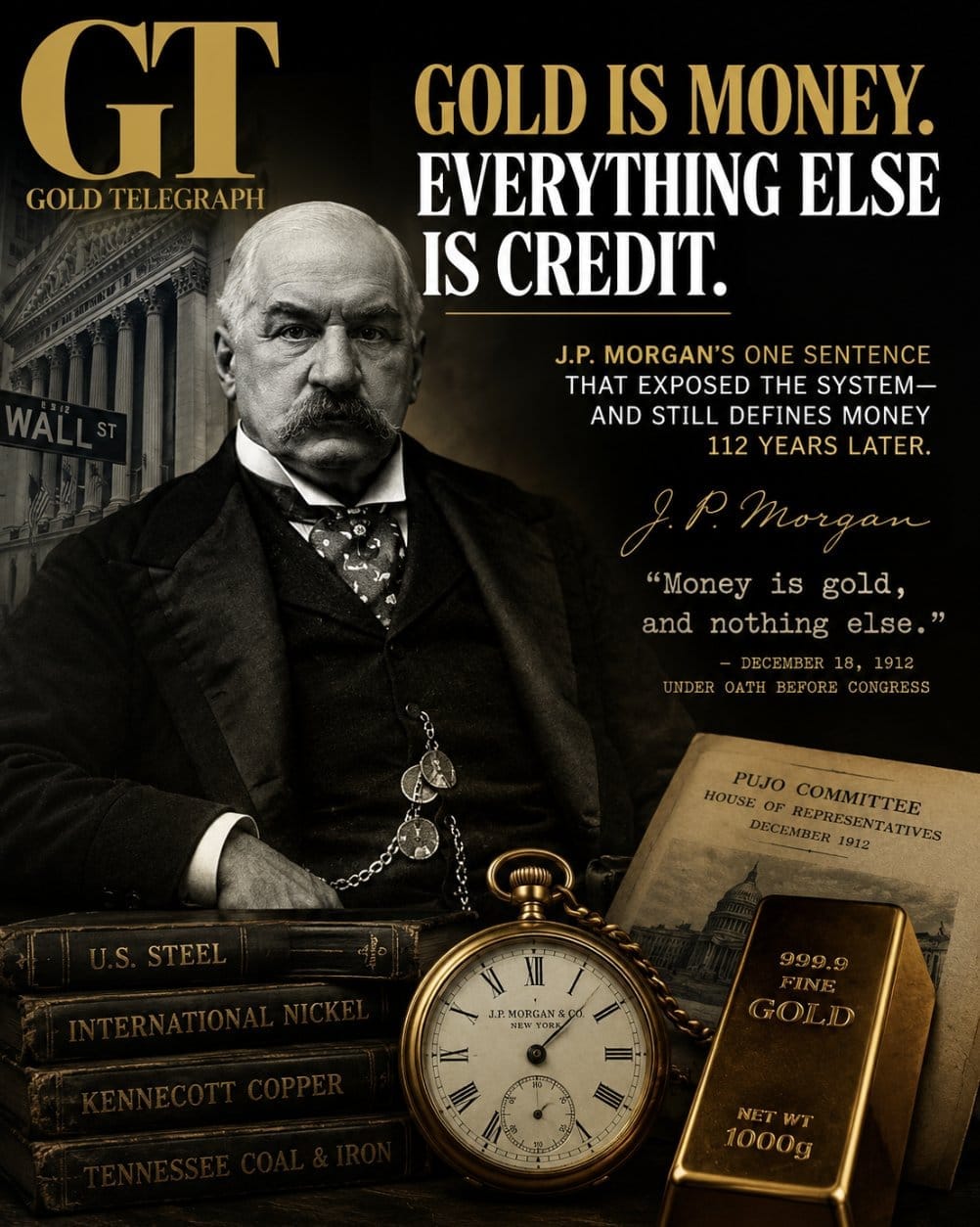
One of the most iconic quotes in gold?
“Gold is money. Everything else is credit.” — J.P. Morgan.
He said it under oath, testifying before Congress in December 1912, a few months before he died. The exact words in the transcript were “Money is gold, and nothing else.”
The old man was 75, half the country hated him, and a congressional committee was trying to prove he secretly controlled American finance.
They asked him to explain money. He gave them one sentence. It has outlived everyone in that room.
Many forget it was Morgan, personally, who coordinated the leading bankers, trust companies, and financiers to inject liquidity into the system during the Panic of 1907.
No Federal Reserve existed.
There was no lender of last resort, no bailout mechanism, no printing press to fire up at 2 a.m.
There was one man in a library on Madison Avenue, locking the presidents of New York’s biggest trusts in a room and refusing to open the door until they pledged the money to stop the run.
He effectively acted as the central bank of the United States, and he prevented a complete collapse of the financial system with little more than his own credibility and a pocket watch.
But here’s the part almost everyone forgets.
Morgan wasn’t a paper man.
The empire underneath all that credibility was built on the gifts of Mother Nature...
Rock, ore, and metal.
He financed things you could drop on your foot.
Start with iron.
In 1901, Morgan assembled U.S. Steel, the first billion-dollar corporation in history and buried inside that deal was control of the Mesabi Range, the greatest iron ore district in America. The world saw a steel company.
Morgan saw the dirt it stood on.
Then came nickel. In 1902, Morgan merged the Sudbury miners and the Orford refinery into the International Nickel Company.
The Sudbury Basin, a deposit seeded by a meteorite strike nearly two billion years ago held most of the nickel on Earth, and nickel-steel armor plate had just become the most strategic material of the naval arms race.
Orford’s owner was given a simple choice by his largest customer: cooperate or lose everything. He cooperated.
Inco would control the nickel market for the next forty years and armor the fleets of the First World War.
Then copper. In 1906, the House of Morgan joined the Guggenheims to form the Alaska Syndicate and develop Kennecott, a mountain in the Alaskan wilderness where the ore assayed as high as 70% copper, so rich it was shoveled straight into sacks without milling.
Getting it out required building 196 miles of railroad across canyons and living glaciers, in temperatures of forty below, to a port that barely existed.
Serious money said it was impossible. Morgan money built it anyway.
Grade attracts capital to the end of the earth.
It always has.
And in the panic year itself, 1907, while Morgan was saving the banking system with one hand, he was absorbing Tennessee Coal, Iron & Railroad into U.S. Steel with the other, with the personal blessing of a president desperate enough to look past his own antitrust crusade.
A coal and iron empire, acquired over a weekend, to stop a financial fire.
Even his rescues were made of rock.
See the pattern. The man who defined money as gold did not spend his life shuffling abstractions.
He spent it financing iron, nickel, copper, coal and settling the ledger in metal.
He understood something that has been carefully unlearned over the past century:
Credit is a promise, and promises are only as good as the collateral and the character behind them.
Gold asks for neither. Gold simply is.
Now consider the timing, because history has a savage sense of humor.
Morgan died in March 1913.
The Federal Reserve was born that same year.
The private lender of last resort was replaced by an institutional one and the institutional one came with a printing press.
In 1913, gold was $20.67 an ounce.
Today it trades over $4,000.
Measured against the metal Morgan called money, the dollar has surrendered more than 99% of its value in the years since the man died and the machine took over.
And the punchline?
The machine knows it.
Central banks, the issuers of the credit, have been buying gold at a record pace, quietly, year after year, vault by vault.
Ask them why and you’ll get a paragraph about diversification.
Morgan answered the same question in one sentence, under oath, in 1912.
Gold is money. Everything else is credit.
The old pirate has been dead for 113 years, and he’s still the most honest central banker we ever had.
If you enjoy stories like this, because share it. I will start writing stories like this every Saturday.
Thank you for reading.
- GT