

My personal obsession with the health of Japan’s economy has finally caught up with me. For years, I have watched what I always believed was an incredibly sick system become more and more entrenched in short-term solutions, solutions that, as you will read, have been woven into the DNA and fabric of one of the most financially engineered economies in the world.
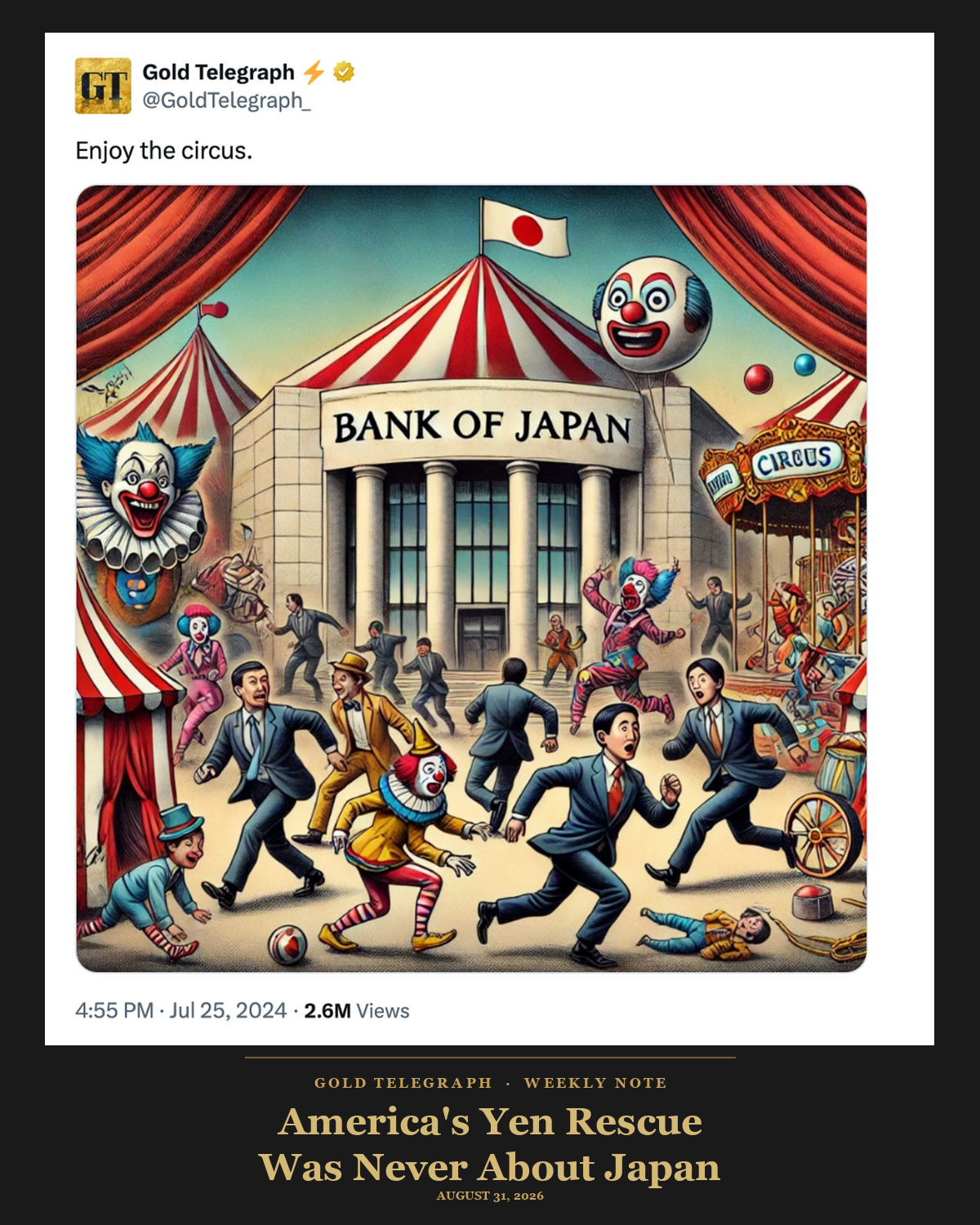
What started as temporary fixes slowly became permanent policy, ultimately creating a form of financial socialism that has left policymakers trapped inside the very system they built. In 2024, I called it a complete and utter circus.
Over two million views later, the circus has only gotten bigger.
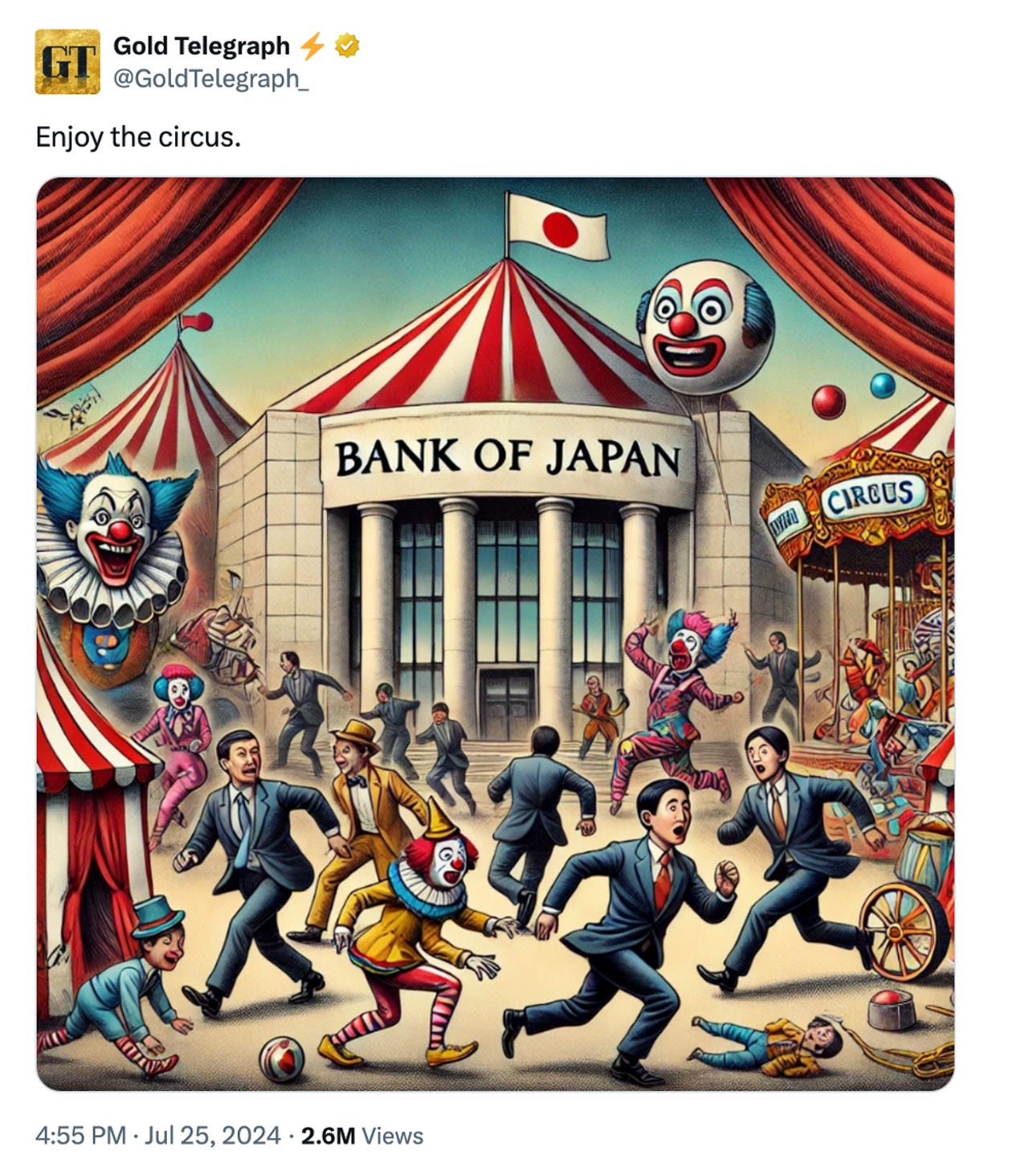
I remember posting that cartoon more than three years ago. A lot of people laughed and thought it was a joke. It was the furthest thing from one. I have spent much of my career watching Japan and, frankly, wanting to pull my hair out as policymakers repeatedly applied short-term solutions to long-term problems.
The problems never disappeared. They were pushed further down the road, allowed to grow larger, more complicated and ultimately more dangerous.
Fast forward a year from when I originally posted that cartoon I created to 2025.
I was on stage in Quebec City with someone I now consider a friend, Michael Gentile, who is widely known as one of Canada’s top resource investors. The conversation got intense as we moved through many of the topics the mainstream public has now become obsessed with in 2026:
De-dollarization, gold, sovereign debt and, ultimately, just how much rope this debt-based financial system has left to hang itself with.
Michael had just walked through the math of U.S. interest payments consuming roughly a third of federal revenue. I then pivoted the conversation toward Japan, almost as an aside.

I said gold is a hedge against stupidity. Then I pointed at the Bank of Japan, which at that point owned over 50% of its own government’s debt, and I almost lost my breath mentioning that its bond yields were already climbing higher and higher despite that.
Unbelievable, I said, what’s going on around the world in debt markets?
Later in that same conversation, talking about the weaponization of the dollar, I made the point that the two largest foreign holders of United States Treasuries at the time were Japan and China.
I framed it as part of the same story, a system where the biggest players in the game are also the ones most exposed to it, and where that exposure was starting to look less like strength and more like a liability nobody had priced in yet.
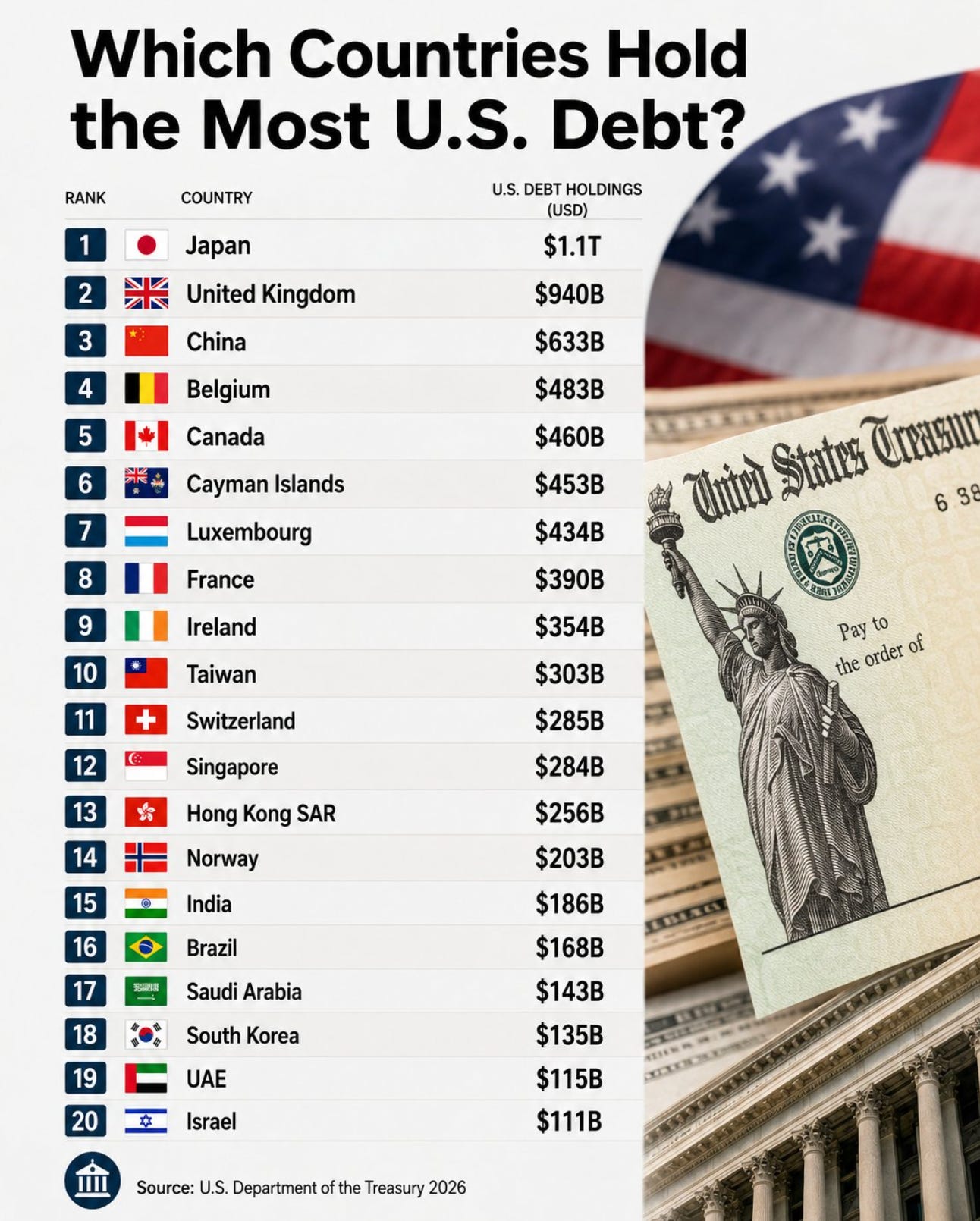
At the time, it was one line in a much bigger conversation about gold and dedollarization.
I didn’t know how fast it would stop being an aside and become one of the most important stories in the macro world, but here we are.
We Have Been Here Before
Forty years ago, Washington and Tokyo staged something spookily similar to this summer’s intervention, except the pressure ran in the exact opposite direction.
In September 1985, finance ministers from the world’s major economies gathered at the Plaza Hotel in New York. They agreed to engineer a controlled decline in the dollar and a corresponding surge in the yen.
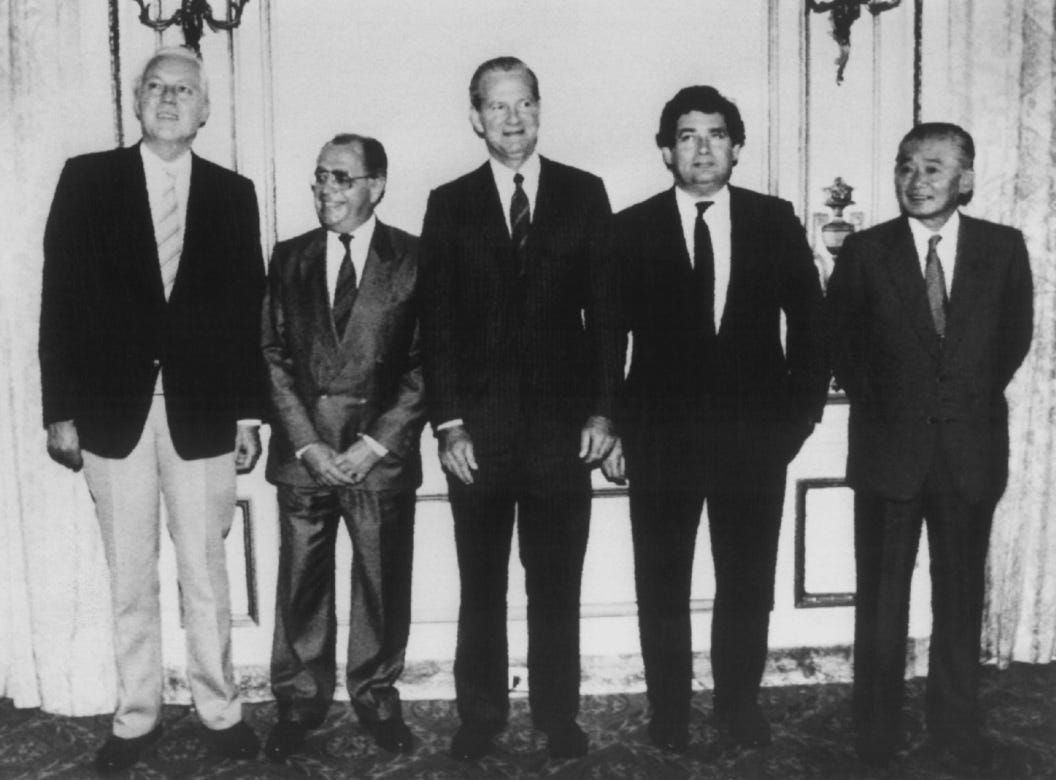
Running point for the American side was Treasury Secretary James Baker, a man with a blunt, muscular approach to currency diplomacy and famously thin patience for any government that complained about US policy without the leverage to back it up.
The Japanese delegation told Baker’s team they could hit the target if no other central bank worked against them.
Baker wasn’t sure it was even possible.
Within weeks, the yen was up more than 10%, landing on target with almost surgical precision. Within two years, it had nearly doubled from 244 yen to the dollar, down toward 121.
Here’s the part almost nobody remembers correctly.
The stronger yen was supposed to cripple Japan’s export machine. It didn’t, not at first. Japanese firms moved up the value chain and absorbed the pain to protect market share.
Meanwhile, that same strong yen turned Japanese banks and investors into overnight giants, flush with a currency suddenly worth twice as much, and they went shopping.
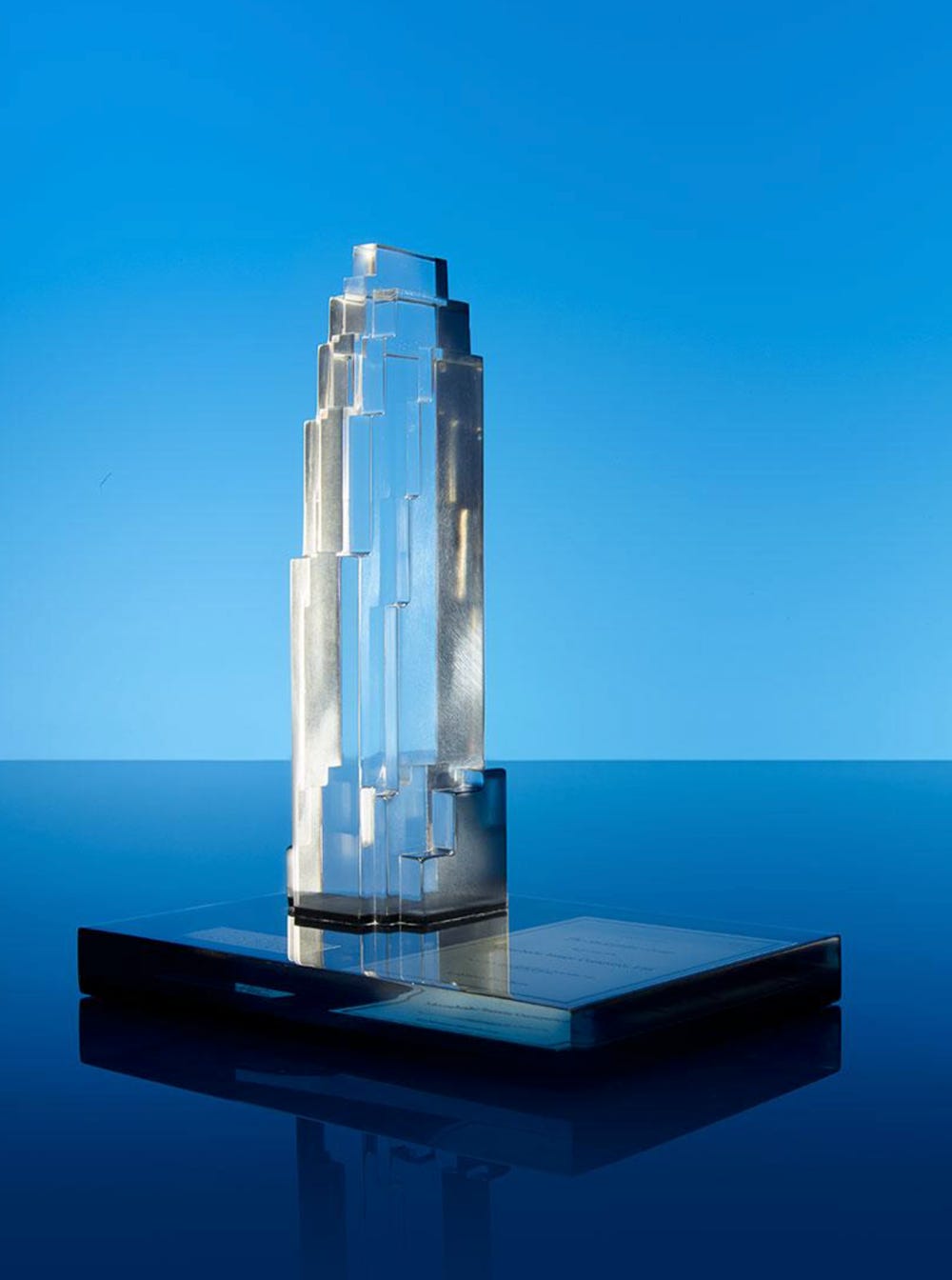
Rockefeller Center.
Pebble Beach.
Some of the most iconic assets in America suddenly had Japanese owners.
At home, Japanese equities tripled by 1989. On paper, the land under the Imperial Palace in Tokyo was worth more than the entire state of California.
Then it all came apart.
The Nikkei had lost 60% of its value by 1992. Land prices eventually fell 80% from their peak, with no meaningful bounce back for decades.
Japan’s growth rate, which had run near 9% a year in the 1960s, collapsed to roughly 1% a year through the entire following decade, and the country never fully got that economic swagger back.
One act of currency engineering in 1985 didn’t just move an exchange rate.
It inflated a bubble, and Japan is, in some ways, still climbing out of the crater left when that bubble burst.
Which brings us to the debt. Japan’s government now carries a load of roughly 251% of GDP, the highest of any major economy on the planet, well above America’s own 121%.
And Japan built a defence, deliberately, against ever being cornered like that again:
It keeps almost all of that debt at home. Only around 7% of Japanese government bonds sit in foreign hands, compared to roughly a quarter of America’s.
Japan learned in 1985 what it costs to have outside pressure dictate the terms of its own currency. I’d bet that lesson is still sitting somewhere in the memory of Japan’s policymakers today.
But wait a second, sit with the irony buried in that fact, because it’s the musical notes this entire story runs on.
The country that spent forty years making sure nobody could ever again do to it what Washington did in 1985 is now the single largest foreign holder of somebody else’s government debt.
Washington’s.
Tokyo insulated its own bonds from outside pressure decades ago. It just never got around to doing the same with the mountain of American paper it was quietly stacking up in the meantime.
This isn’t a rerun of 1985. It’s the mirror image of it.
And that reversal, Japan now holding the leverage instead of absorbing it, is exactly what made the events of this summer necessary.
Whatever It Takes
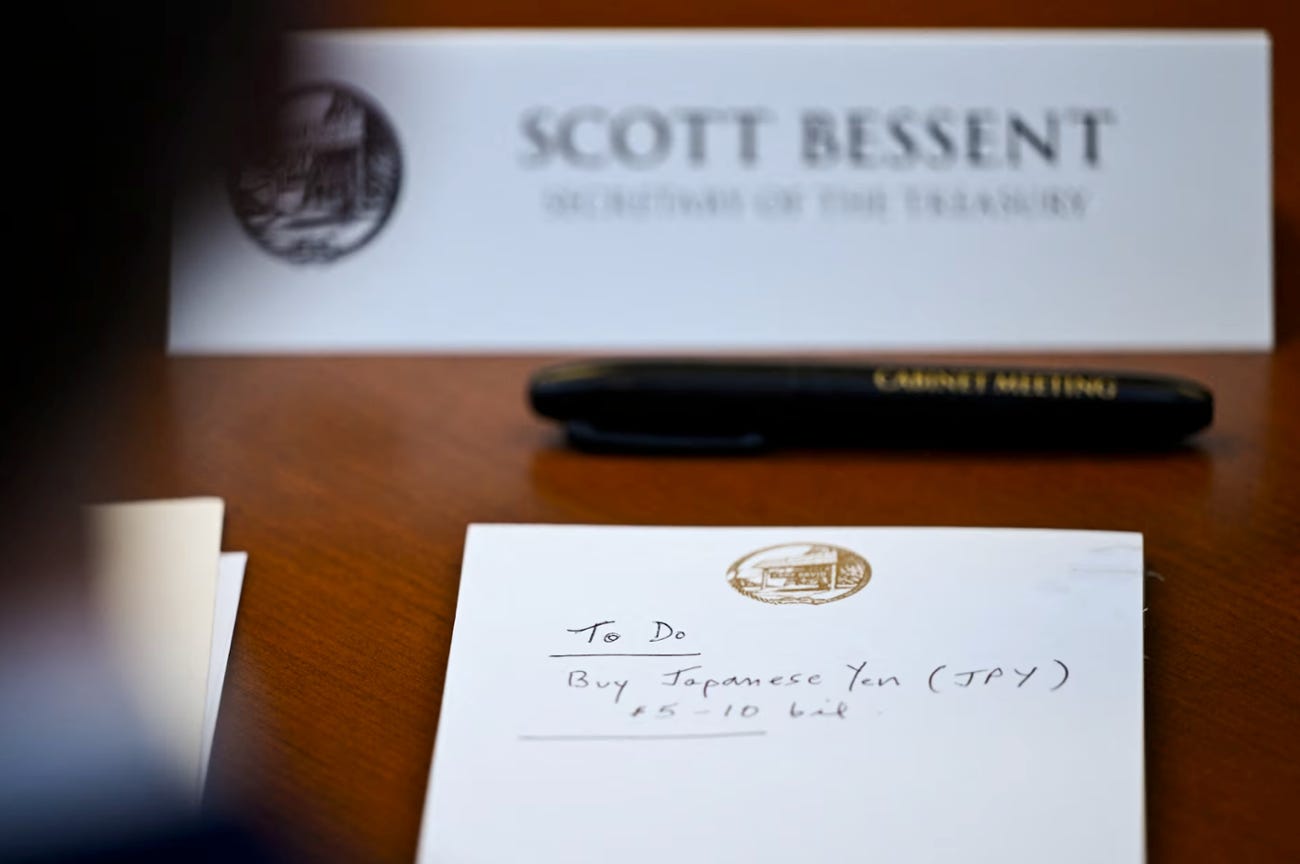
On July 31, the US Treasury did something it hadn’t done since 1998. It stepped in, alongside Japan, to defend the yen.
The yen was sliding toward a 40-year low against the dollar. Scott Bessent called the intervention delivering for a trusted partner. “Economic security is national security,” he said.
Whatever it takes. That was the message.
Here’s the part that should have made front pages and didn’t.
The New York Fed didn’t sell dollars to fund that intervention.
It sold EUROS routed quietly through Goldman Sachs and Morgan Stanley and used the proceeds to buy yen.
Read that again.
The United States defended Japan’s currency by spending Europe’s.
That is not how this is normally done. And it wasn’t an accident.
There are two explanations for why, and I think both are true.
The polite one:
Selling dollars outright would have looked like Washington abandoning its strong-dollar stance, at the exact moment inflation is already running hot.
A softer dollar makes that worse and ties the Fed’s hands on rates.
The less polite one, and the one that matters:
Japan’s Ministry of Finance has reportedly been leaning on the Fed’s FIMA repo facility, pledging its own Treasury holdings as collateral to borrow dollars instead of selling those Treasuries outright.
Put those two facts side by side, and the entire operation reads differently.
This was never really about rescuing the yen out of allied generosity.
It was about making sure Japan never became a forced seller of US government debt.
Washington wasn’t protecting Tokyo.
Washington was protecting its own bond market from a stress test it didn’t want to run.
The Bill Comes Due Somewhere
Here’s why none of this was optional.
Japan is the single largest foreign holder of US Treasuries on the planet. Roughly $1.19 trillion, as of the most recent Treasury data, about 13% of everything foreign hands hold.
Nobody else is close.
China, which has been selling US Treasuries and buying gold, holds around $ 700 billion, and many anticipate it will continue to shrink its Treasury position.
For decades, that Japanese appetite for US debt wasn’t really a choice. It was the mechanical output of a trade that quietly financed the modern world:
The yen carry trade.
Borrow yen at near-zero, sometimes negative, interest rates. Buy dollar assets that actually pay something. Pocket the spread.
Japanese insurers, pension funds, and banks ran this trade at industrial scale for the better part of two decades, because Japan simply had nowhere else to put money and earn a return.
That demand is a big part of why American borrowing costs stayed as low as they did, for as long as they did.
It was never advertised that way. It never needed to be. It just worked, quietly, in the background, like plumbing always does until the day it doesn’t.
That equation is now breaking.
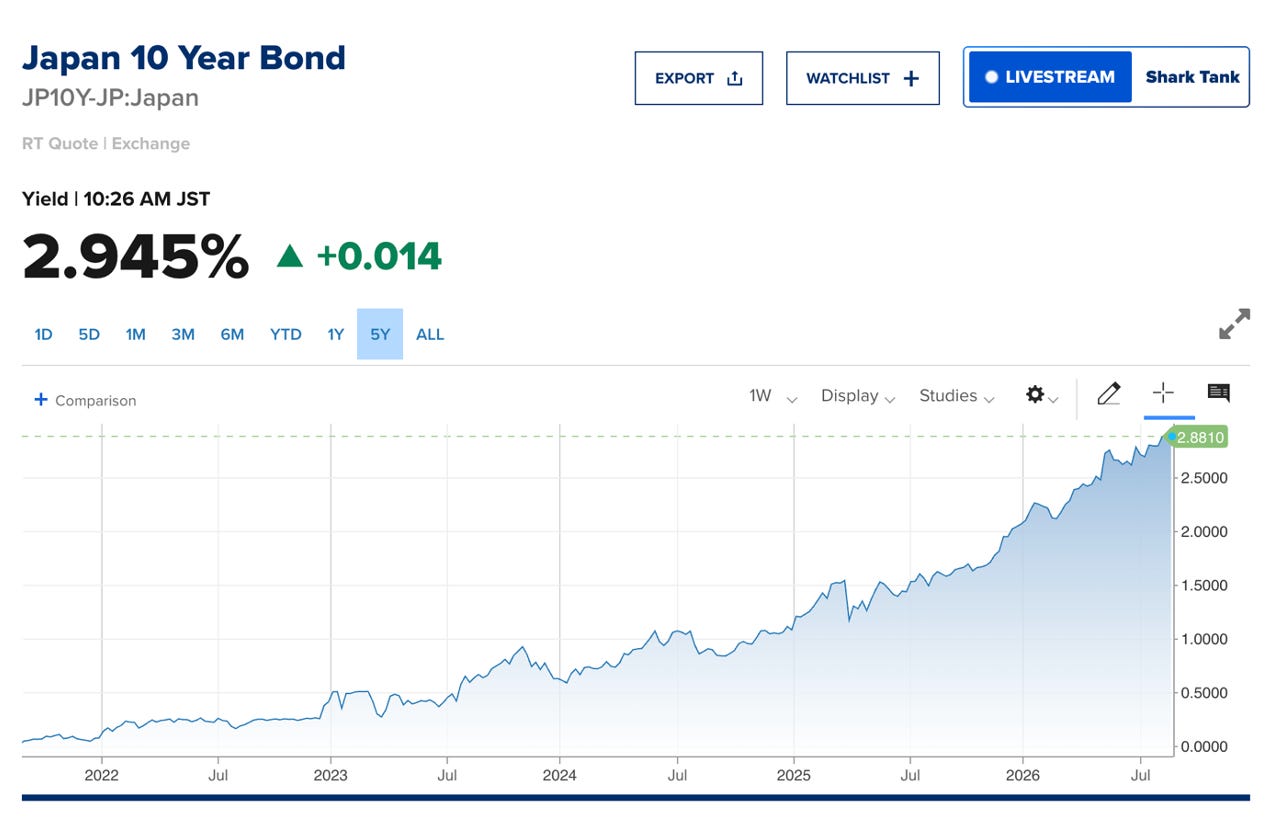
The Bank of Japan is raising rates and letting JGB yields climb.
Japan’s 10-year is trading near levels not seen in a generation. For the first time since most traders currently working were in diapers, Japanese institutions can earn a real return at home, in their own currency, with zero currency risk.
The carry trade is losing its entire reason to exist.
And unwinds like this don’t happen gently.
They spiral.
Investors who borrowed yen have to buy yen back to repay those loans.
That pushes the yen higher.
A higher yen makes the trade even less attractive. That triggers more unwinding.
Japan already sold roughly $30 billion of US Treasuries in a single quarter this year, the fastest pace of selling in four years.
Now run the scenario you should be clearly wondering about: what happens if Washington sits this one out?
A yen left to collapse on its own makes imported food and energy brutally expensive for Japanese households, already a live political grenade for Prime Minister Takaichi.

The standard playbook for a country defending its own currency without outside help is blunt:
Sell dollar assets, mostly Treasuries, and use the proceeds to buy your own currency back.
Do that at scale, out of a $1.19 trillion position, and you’re not just moving the yen anymore.
You’re dropping a large, price-insensitive seller into a Treasury market that’s already straining to absorb record issuance.
Treasury yields don’t move in a vacuum.
Every mortgage rate, every corporate loan, every equity valuation model in America is anchored to that curve. A disorderly Japanese sell-down doesn’t stay a Japan story for more than about a week.
It becomes an American borrowing-cost story, fast.
That is the real reason for the intervention.
That is the real reason it was funded in euros.
Washington needed Japan to have a reason to stop selling Treasuries without the optics of a direct yen bailout, and without adding a second seller into an American bond market that’s already nervous about who’s going to absorb the next few years of US deficits.
The carry trade was never just a clever Japanese arbitrage.
It became a load-bearing wall in the US Treasury market.
Now that Japan has a reason to walk away from it, America has a direct incentive to keep the yen from falling so far, so fast, that Tokyo has no choice but to sell the wall out from under itself.
The Part Europe Isn’t Saying Quietly Anymore
The European Central Bank was not consulted before the euro sale happened.
Christine Lagarde and Scott Bessent didn’t speak about it until a day after the trade had already cleared.
This is where things get complicated. The United States Treasury Secretary clearly understands what is at stake and will rightfully always put American interests first, even before its allies.
Still, the Europeans are clearly caught in the middle of this mess.
My takeaway for the Europeans not being briefed is a pretty honest one:
This situation was spiralling out of control and fast.
Why do I think that?
Coordinated currency interventions have always been rare enough to be memorable when they happen such as the 1985 Plaza Accord, the 2000 rescue of the euro, the 2011 post-tsunami yen intervention.
Each of those was arranged with real advance alignment among the central banks involved. This one wasn’t.
This time, Washington skipped communicating completely, spent someone else’s currency to solve its own ally’s problem, and explained itself only after the fact.
Senior ECB officials called it a break from decades of cooperative norms.
Robin Brooks at Brookings was blunter; he called the whole structure self-defeating and confusing to markets.
It turns out that discomfort didn’t stay contained to one awkward weekend.
Reuters reported that European central bankers left this year’s Jackson Hole symposium, the one gathering where the entire world’s central bankers compare notes face to face, genuinely rattled about what comes next out of Washington.
Fed officials tried to reassure their European counterparts that existing commitments would hold.
The joint yen intervention was a shot heard all over the world.
European officials are also uneasy about Bessent’s plan to increase buybacks of longer-dated Treasuries, funded by issuing more short-term debt.
The uncomfortable question underneath that plan:
Is Washington engineering lower long-term borrowing costs through the back door, and could that eventually mean leaning on the Fed itself to become the buyer of last resort?
The Treasury’s official answer is that this is a liquidity operation, not a ceiling on rates. Not everyone in Europe is buying that answer.
There was even quiet talk of the Fed’s dollar swap lines, the emergency facilities that supply dollar liquidity to major central banks during periods of stress.
Some officials wondered aloud whether rising political tension could eventually put those facilities at risk too. Nothing suggests that’s imminent.
The fact that the question is being asked out loud, at Jackson Hole, tells you where trust currently sits.
Line all of this up and you stop seeing an awkward weekend. You start seeing a pattern:
The United States making unilateral moves with global consequences, and offering explanation instead of consultation.
If this is how Washington behaves over a currency wobble in a friendly country, ask yourself what it says about the hierarchy.
The dollar is protected. Japan is worth protecting because of the Treasury exposure sitting underneath it.
The euro was simply available… inventory to be spent quietly, and explained later, if anyone asked.
You all are getting an up-close view of the world of floating exchange implemented post-1971, where value is arbitrary, and exchange rates can literally change up or down overnight.
The Machine Is Already Cracking Underneath
Strip away the theatre of the July 31 intervention, and Japan’s own financial system tells a rougher story… one that’s been building for a while, mostly out of sight.
The Bank of Japan’s share of outstanding Japanese government bonds dipped below 50% for the first time in three and a half years.
For over a decade, the BOJ was effectively the buyer of last resort for its own government’s debt. That’s now unwinding, deliberately, as a matter of policy. Somebody else has to step in and buy what the central bank stops buying.
The people who already own a mountain of that debt are hurting.
Japan’s four largest life insurers, Nippon Life, Dai-ichi, Sumitomo Life, Meiji Yasuda are sitting on a combined ¥15.13 trillion, roughly $96 billion, in unrealized losses on domestic bonds.
Up 7% in a single quarter. These are firms that bought JGBs during the years of near-zero and negative rates, and are now watching that paper get repriced as yields climb.
They’ll tell you these are only paper losses, because insurers generally hold to maturity. That’s true, right up until it isn’t, until a wave of policy cancellations forces real selling, at real prices, into a market that’s already thin.
Meanwhile, the pool of money sitting on top of all this keeps growing.
Master Trust Bank of Japan’s assets under custody just crossed one quadrillion yen, driven by a historic equity rally.
Sit with that image for a second.
A bond market quietly bleeding out. An equity and savings pool inflating on top of it. Often inside the very same institutions, at the very same time.
When the State Starts Eyeing Everything That Isn’t Nailed Down
When a government is stretched, it looks at what it already owns.
Prime Minister Takaichi pushed through a plan to slash the consumption tax on food from 8% to 1% for two years, an estimated ¥5 trillion annual cost.
She’s said she won’t fund it with fresh debt. So where does the money come from?
One idea now floating out of the ruling party:
Sell down the Bank of Japan’s ¥37 trillion ETF stockpile faster than planned.
A senior LDP lawmaker noted that at the current pace, unwinding those holdings would take roughly a century and stock prices are high enough right now that nobody would even notice a faster sale.
Translation, in plain English: the central bank’s own balance sheet is starting to look like a spare government revenue line.
At the same time, Tokyo has been leaning on the Government Pension Investment Fund… the largest pension fund on Earth, roughly $1.8 trillion, to bring more of its money home instead of parking it abroad.
Yes, my obsession with Japan for nearly a decade has clearly been for a reason, and it’s the mess we are now watching unfold in real time that has turned into a global problem.
Where This Leaves Us
None of these threads are separate stories.
The intervention.
The euro sale.
Jackson Hole.
The insurer losses.
The ETF stockpile.
They are the same story, told from six different rooms.
A G7 country spent decades running the most extraordinary monetary experiment in modern history.
Now it’s discovering, in real time, what it costs to unwind. At the same time, its largest ally quietly spends a third party’s currency to keep its own fingerprints off the operation, and its own central bankers privately admit they can’t guarantee what happens next.
On that stage in Quebec City, I pointed to the Bank of Japan owning roughly half of its own government’s debt as the perfect example of why I have long viewed gold as a hedge against stupidity.
I didn’t have any of these numbers then… not the euro sale, not the Plaza Accord parallel, not the $1.19 trillion.
I just had the instinct that something in the machine was already straining.
Watch Japan.
Not because of its world-class sushi that I personally love.
But because it’s the place where decades of easy money are finally coming due and everyone standing nearby, such as insurers, pension funds, the ECB, and an entire continent, is finding out in real time exactly how much say they ever actually had in the plan.
My strange obsession with Japan finally makes sense to me.
I wasn’t watching because I knew exactly how the story would end. I was watching because I couldn’t believe how long they could keep it going.
It was a tragic comedy playing out in real time, a country fighting the consequences of yesterday’s decisions with even bigger decisions today, always buying another day and sending the bill further down the road.
Maybe that is why I could never look away.
I was never trying to predict the ending. I just wanted to understand the madness well enough to tell the story when the rest of the world finally started watching.
Until next time, and thank you for reading my first long-form piece here on Substack.
It feels damn good to be writing like this again. In many ways, it takes me back to the pieces I published on ZeroHedge all those years ago, following the things that didn’t quite make sense and seeing where they led.
- The Gold Telegraph.